Some people describe it as two sets of needs pulling in opposite directions. One part of you wants the same routine every day. The other part is bored of it by Wednesday. If that sounds familiar, there may be a reason.
AuDHD is a community word for being both autistic and ADHD. It isn't a separate diagnosis. It's a shorthand people use to describe what life can feel like when the two show up together, and it's a word more and more parents and adults are reaching for, often after a late “aha” moment.
Why we're hearing about it more
For years, the diagnostic manual most clinicians use didn't allow autism and ADHD to be diagnosed in the same person. That changed in 2013 with the DSM-5. Since then, research has shown just how often they overlap.
Estimates vary a lot depending on who is studied and how. One large review found that around 4 in 10 autistic people also meet criteria for ADHD at some point in their lives (Rong et al., 2021), and other reviews describe figures higher still (Hours et al., 2022). Looking the other way, about 1 in 5 children and teens with ADHD also meet criteria for autism (Hollingdale et al., 2020). In other words, AuDHD isn't rare. It's simply been easy to miss.
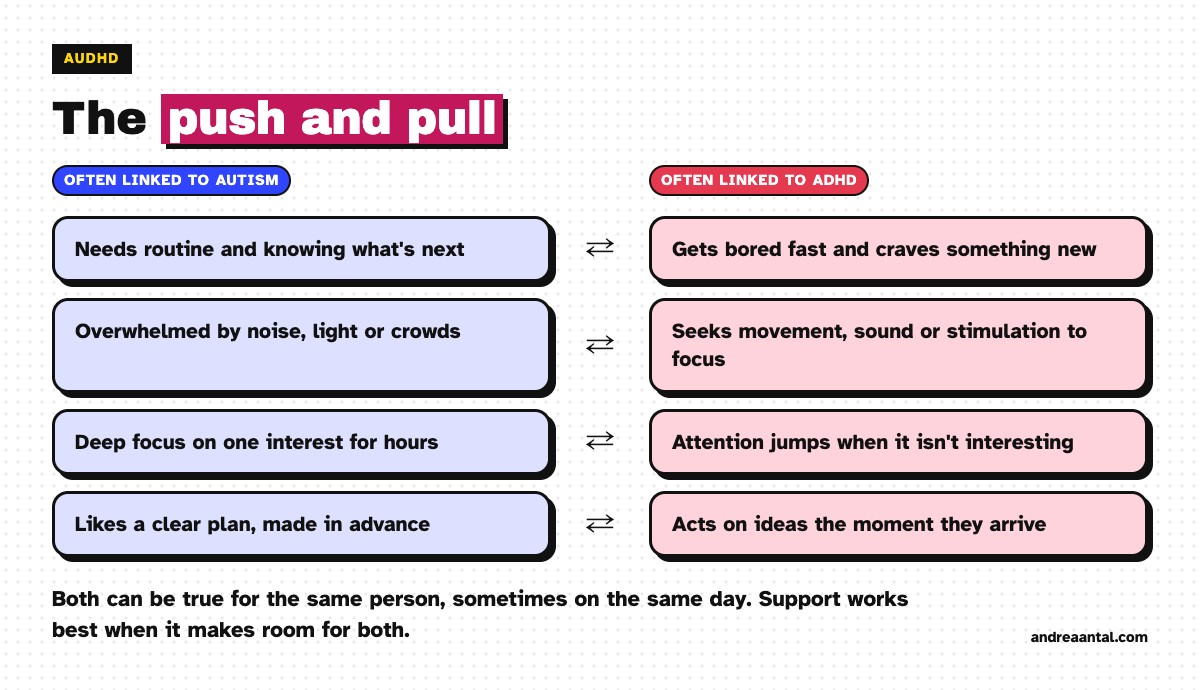
The push and pull
Autism and ADHD can share some traits, like sensory sensitivity or trouble with transitions. They can also pull against each other, which is what makes AuDHD feel so confusing from the inside.
What it can look like day to day
Everyone is different, but these patterns come up often:
- Needs a predictable morning, yet gets bored of the same breakfast
- A meltdown or shutdown after a day that “went fine”
- Knows everything about a favourite topic, but can't start the essay
- Group work and noisy classrooms are draining
- Spots patterns others miss
- Open-plan noise and constant pings wear them down by lunchtime
- Wants connection, but needs time alone to recover
- Direct, honest words get misread as rude
- Hours of hyperfocus, then a crash
- Hard to start a task, and just as hard to stop once going
Why it's often missed
One can hide the other. A child's restlessness or impulsivity may get noticed first, while their need for sameness is put down to personality. Or autism is identified early, and later attention struggles are seen as part of it. Many people, especially girls and women, also become skilled at masking, working hard to look “fine” while running on empty.
It's also common for moms and dads to recognize themselves while learning about their child. If that's you, you're in good company, and your own needs matter here too.
Six ways to make room for both
1. Same structure, different content. Keep the frame steady and let the details change. Homework always happens after a snack, but your teen picks the order. Breakfast rotates between three favourites.
2. Check the senses first. Before asking for effort, look at the environment. Noise-cancelling headphones, softer lighting, or a movement break can free up a surprising amount of energy.
3. Give transitions a runway. A ten-minute heads-up, a visual timer, or a short “landing” activity makes switching easier for both brains.
4. Use interests as fuel. Connect a dull task to something they love. Practise math with sports stats, or write the report about a favourite game.
5. Plan recovery, not just rewards. Quiet time after school or work isn't a treat to be earned. For many AuDHD people, it's what makes the next day possible.
6. Say what you mean. Clear, direct language and written follow-ups reduce guesswork. Ask “Is now a good time?” rather than hinting.
To map your own drains and recharges, try my free printable Energy planner.
Getting clarity
Only a qualified clinician, such as a psychiatrist, psychologist, or developmental pediatrician, can assess for autism and ADHD. If both seem possible, it's worth asking whether the assessment will look at both. You can read more about how ADHD is diagnosed and conditions that often come along with ADHD.
Coaching doesn't diagnose, but it can help you build routines and systems that respect how your brain works, with or without a label.
You don't have to choose between your needs. The goal is a life with room for both.
Want a head start? Try one of my free two-minute quizzes, or join the waitlist to hear when coaching opens.
Research mentioned: Rong, Y., et al. (2021). Prevalence of ADHD in individuals with autism spectrum disorder: A meta-analysis. Research in Autism Spectrum Disorders, 83. doi.org/10.1016/j.rasd.2021.101759. Hours, C., Recasens, C., & Baleyte, J.-M. (2022). ASD and ADHD comorbidity: What are we talking about? Frontiers in Psychiatry, 13. doi.org/10.3389/fpsyt.2022.837424. Hollingdale, J., et al. (2020). Autistic spectrum disorder symptoms in children and adolescents with ADHD: A meta-analytical review. Psychological Medicine, 50(13). doi.org/10.1017/S0033291719002368.