It's 9 a.m. You know exactly what needs doing. You even want to do it. And somehow it's 10:30, you're still in the same spot, and you feel worse by the minute. If that's familiar, you're not lazy. You're stuck, and stuck has causes.
What people mean by ADHD freeze mode
“ADHD freeze mode,” sometimes called ADHD paralysis, is an everyday phrase rather than a diagnosis. It describes the gap between intending to do something and actually starting. That gap comes from executive function skills, like getting started, deciding what comes first, and managing the feelings a task brings up. When a task is vague, dull, or overwhelming, those skills can struggle to switch on.
What autistic inertia adds
Autistic people have long used the word inertia to describe difficulty starting and stopping. Like the physics law, a body at rest tends to stay at rest, and a body in motion tends to stay in motion. In one study, autistic adults described inertia as one of the biggest challenges in their lives (Buckle et al., 2021). In another, interviewees also described its upside: deep, joyful absorption once they were finally moving (Rapaport et al., 2023).
For people who are AuDHD, both can stack up: hard to start, then hard to stop once you're in it.
What being stuck can look like
- Sitting with the homework page, saying “I don't know how to start”
- Big feelings when asked to stop a game
- An assignment open for hours with nothing typed
- Stuck in bed on a free Saturday, wanting to get up
- Unanswered emails piling up
- The laundry basket that waits for days
- The life-admin pile: forms, renewals, appointments
- Losing an afternoon deciding which task to do first
Your unstick menu
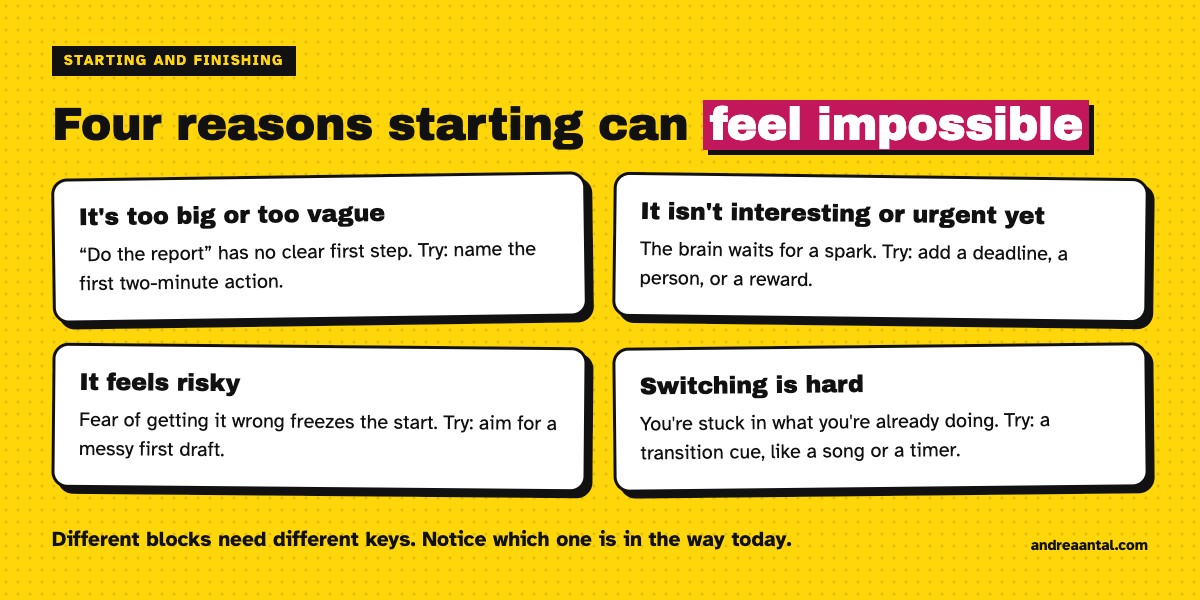
- Shrink it. Find a first step so small it feels almost silly: “Open the document and type the title.”
- Add a person. Work alongside someone, in the room or on a video call. This is often called body doubling.
- Add a spark. Race a timer, put on a favourite playlist, or move to a different spot.
- Lower the bar. Aim for a messy first draft. You can't edit a blank page.
- Use a transition cue. Stand up, get a glass of water, or play the same song each time you switch tasks.
- Move your body. A short walk or a stretch can help the brain shift gears.
- Plan the stop, too. If stopping is the hard part, decide in advance: an alarm across the room, or “after this chapter.”
Want to put this on paper? Try my free Break It Down worksheet, or print the Unstick menu and keep it by your desk.
For parents
“Just start” is the most natural thing to say, and it rarely helps. A stuck child or teen usually wants to start. They need a smaller door to walk through.
When to look further
If feeling stuck is constant, or comes with low mood, losing interest in things you usually enjoy, or changes in sleep, talk with a doctor. Burnout, anxiety, and depression can look a lot like freeze, and they deserve care in their own right.
Stuck isn't a character flaw. It's a sign that the task needs a different key.
Want a head start? Try one of my free two-minute quizzes, or join the waitlist to hear when coaching opens.
Research mentioned: Buckle, K. L., et al. (2021). “No way out except from external intervention”: First-hand accounts of autistic inertia. Frontiers in Psychology, 12. doi.org/10.3389/fpsyg.2021.631596. Rapaport, H., et al. (2023). ‘I live in extremes’: A qualitative investigation of Autistic adults' experiences of inertial rest and motion. Autism, 28(5). doi.org/10.1177/13623613231198916.