Your child knows the answer. You practised it together last night. Then the test comes back: a 6 copied as a 9, a minus sign read as a plus, the last question left blank. Your child shrugs: “I just made silly mistakes.” The report says something like “needs to check work more carefully.” And if we’re honest, the word in our own heads is often “careless.”
I’ve had that conversation more times than I can count, as a mom of children who learn differently and as an ADHDer myself. Here’s what I’ve learned: most “careless” mistakes have very little to do with caring. They come from the skills that sit underneath the schoolwork, the ones that help us start, keep track, and check. Those are executive function skills, and they grow at different speeds in different children.
What’s really going on
The same mistake can have very different causes. See if you recognize any of these:
- Understood the problem, then focus drifted for a second
- Looks like: a misread sign, a skipped line
- Long division or a three-part instruction overloads their mental “workspace”
- Looks like: a step falls out halfway through
- Begins before finishing the question, just to get it over with
- Looks like: answering a different question
- “Check your work” means nothing if you don’t know what to look for
- Looks like: a quick glance and “done!”
- Anxiety uses up the brain space needed for the task
- Looks like: freezing, guessing, or saying “I don’t care”
Six things to try at home
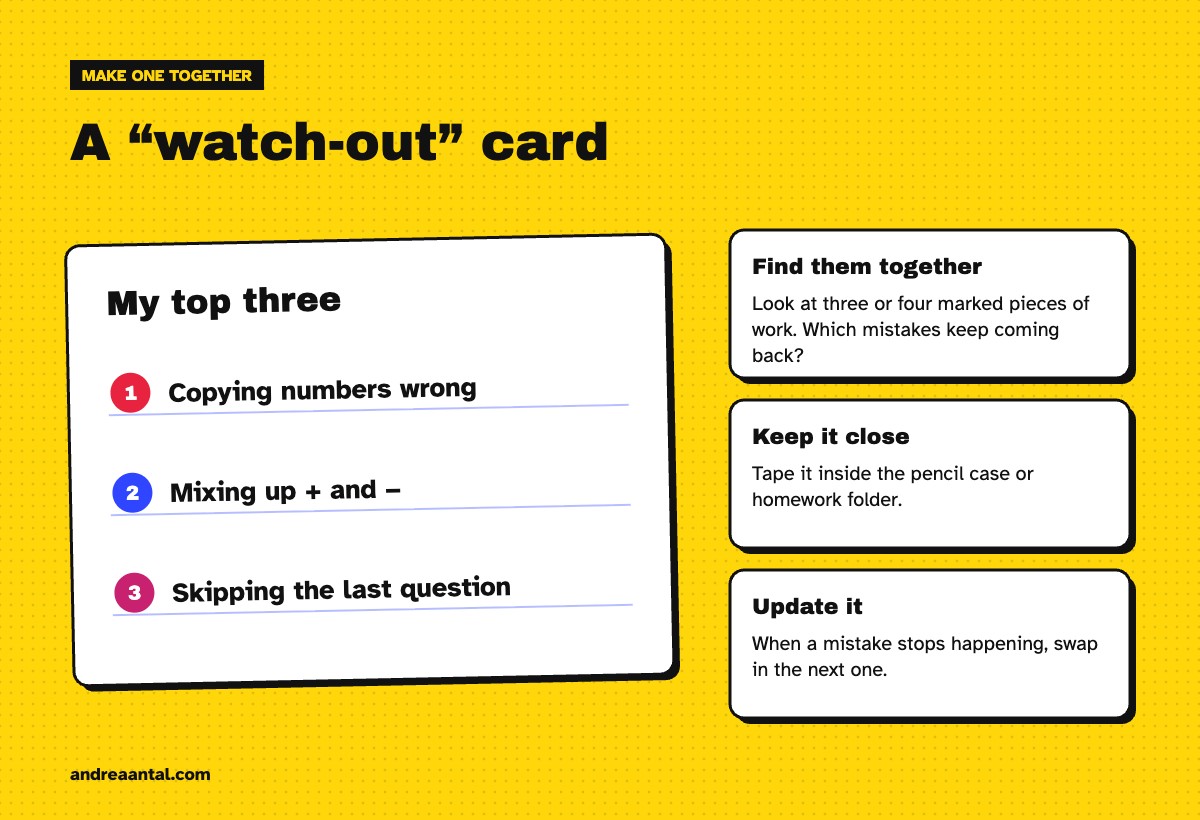
1. Find their top three. Spread out three or four pieces of marked work. Circle the mistakes together and sort them into piles. Most children make the same two or three kinds again and again. Give each one a kind, simple name, like “number swaps” or “sneaky signs”.
2. Make a watch-out card. Write their top three on a card and tape it inside the pencil case or homework folder. When one stops happening, celebrate and swap in the next.
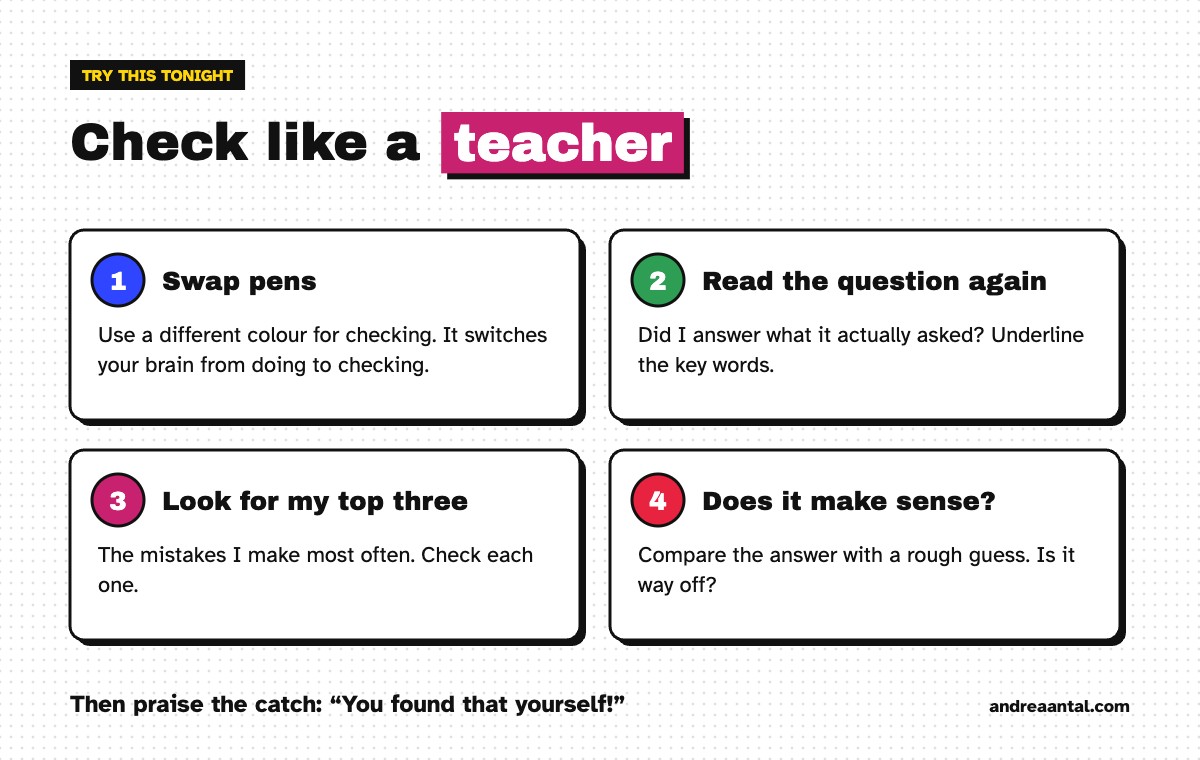
3. Check like a teacher. When the work is done, swap to a different colour pen. It sounds small, but it helps the brain switch from doing to checking. Then go through four quick questions.
4. One step at a time. Turn long instructions into a short numbered list. For worksheets, cover everything except the question they’re on with a piece of card.
5. Read it twice, then guess. For word problems: read it, read it again, then make a rough guess. If the final answer is far from the guess, that’s the signal to look again.
6. Praise the catch. “You found that yourself!” builds the checking habit faster than a perfect page ever will. And if worry is part of it, start homework with something easy and keep timers out of it.
Words that help
Talking to school
Teachers see a lot of red pen. A short, specific note helps them see the pattern too. You could send something like this:
“Hi Ms. ___, I’ve noticed that [name] understands the method but often drops a step in longer problems. At home we’re trying a short checklist and checking in a different colour, and it’s helping. Could we try a step-by-step layout or a checklist in class too? Happy to share what’s working.”
When to look further
If the mistakes are frequent, getting worse, or coming with a lot of stress, talk with your child’s school and, if needed, a qualified clinician. Coaching doesn’t diagnose, but it can help your family put recommendations into practice day to day.
Your child isn’t careless. They’re learning a skill nobody has taught them yet.
Want a head start? Try one of my free two-minute quizzes, or join the waitlist to hear when coaching opens.