If you've ever spent an evening hunting for homework that may or may not exist, this one's for you. I'm an ADHDer myself, diagnosed late, and a mom of children who learn differently. I'm also training to become an ADHD coach, and I founded WizdoBee and The Bully Effect. Whichever hat I'm wearing, I keep running into the same problem: a school system built for the "average" student, and a whole lot of children who were never average to begin with.
Not more children, just better at noticing
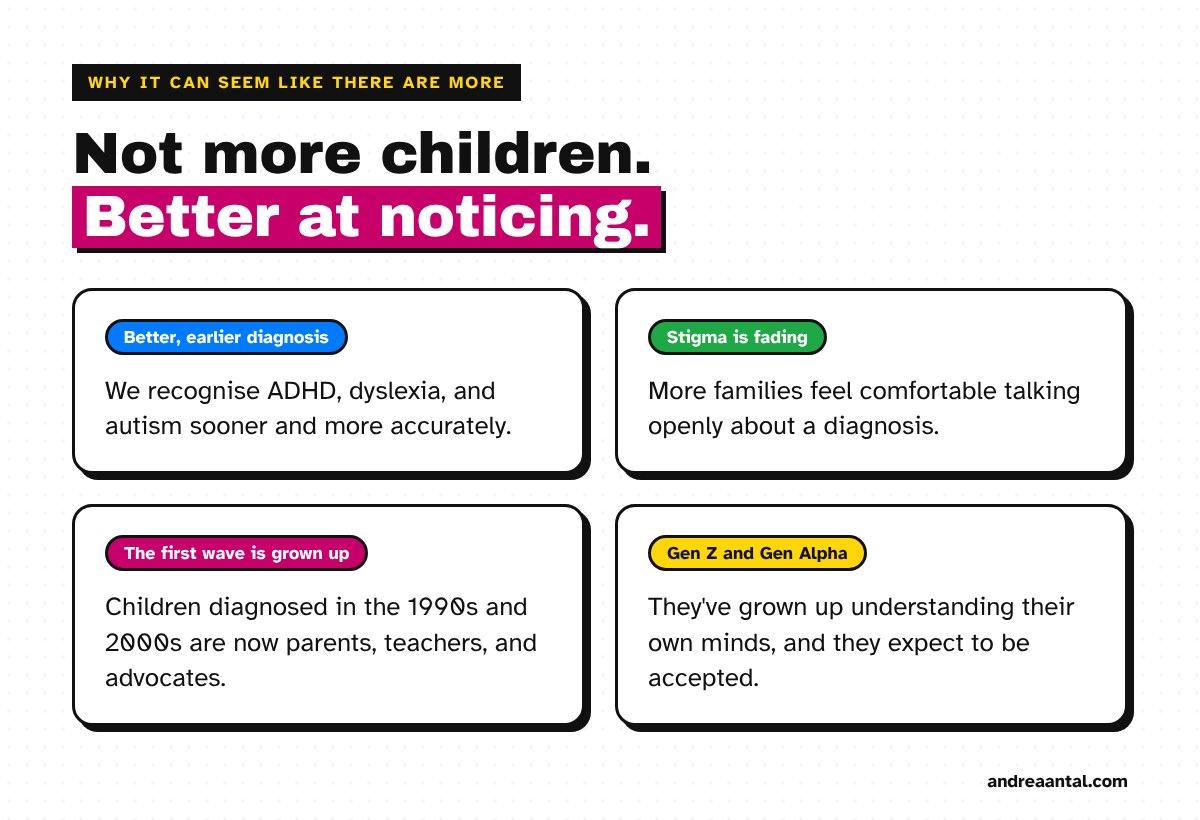
So, are there really more children with ADHD, dyslexia, or autism these days? Not really. They were never missing. We're just much better at spotting them now, and earlier. The stigma is slowly fading, so families feel more comfortable talking about it. The first children diagnosed back in the 1990s and 2000s are all grown up, and lots of them are now parents, teachers, researchers, and advocates who are speaking up. Right behind them are Gen Z and Gen Alpha, who've grown up understanding how their own minds work. They expect to be accepted, not corrected. Honestly? Good.
Why school can feel so hard
The trouble is, schools haven't caught up. They still reward fitting in, and most lessons are still pitched at the middle of the class. Meanwhile, students are expected to keep track of more than ever: different systems, different routines, and different expectations for every subject. When something is forgotten or lost again, it's tempting to call it a character flaw. "If they'd just try harder…" Very often, though, it's executive function: the brain's planning, organizing, and keeping-track skills. Those are exactly the skills ADHD affects. Build a system that leans hardest on them, and some children will always look lazy when they're actually working twice as hard.
Teachers are stretched too
Let's be clear, teachers aren't the problem either. Classrooms have changed a lot in the years since the pandemic. Students are more anxious, attendance is harder to hold onto, and so many teachers say they're running on empty. They're expected to be instructors, counsellors, behaviour managers, and data clerks, usually for a full class of very different learners, with little time and even less training. That's how burnout happens. Telling them to "differentiate more" without changing anything else just shifts the weight from the student's shoulders to the teacher's. This is a systems problem. It's time to rethink one-size-fits-all, not keep patching it.
This is about equity too. Fair doesn't mean everyone gets the same thing. It means everyone gets what they need to take part and do well. A child's race, culture, language, gender identity, and family resources can all affect whether they're assessed in the first place, how their behaviour gets read, and how safe they feel just being themselves at school. A school that works for every mind sees the whole child. It also works hard on stigma, so no family ever feels embarrassed to ask for help.
Understanding goes both ways
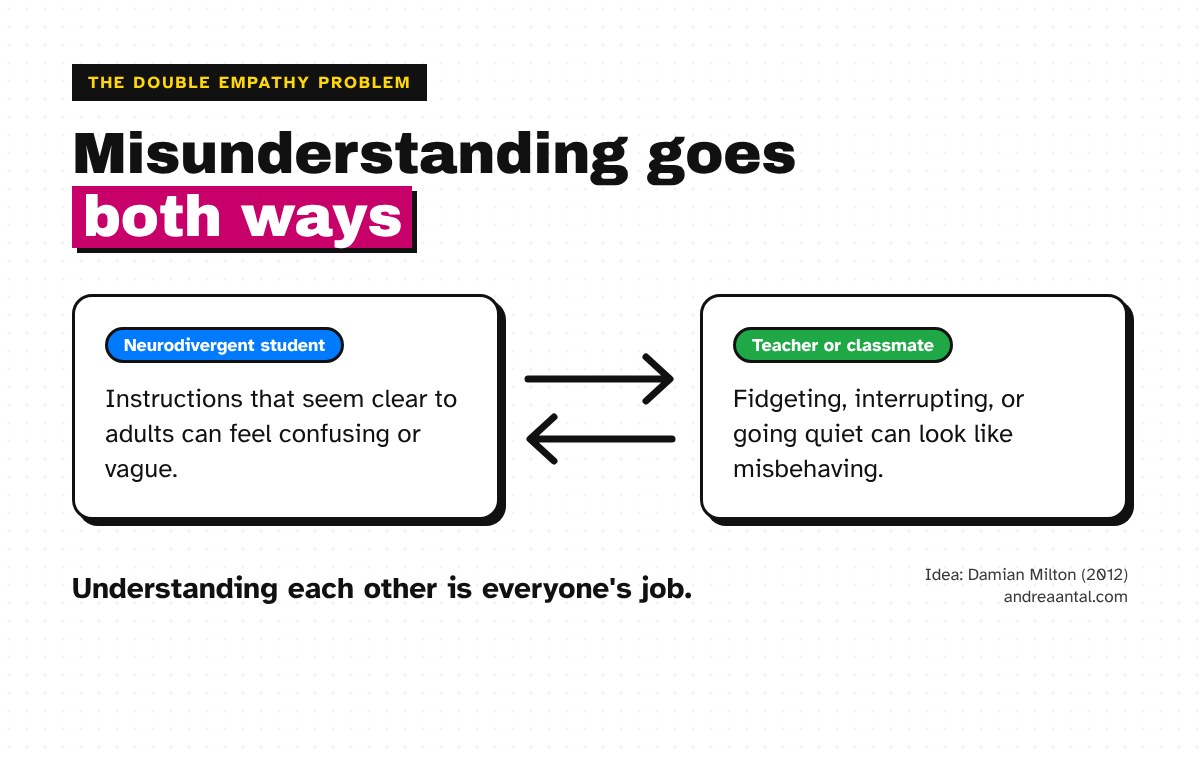
One idea that really changed how I think about all this is what the researcher Damian Milton calls the double empathy problem. Put simply, when neurodivergent and neurotypical people misunderstand each other, the misunderstanding goes both ways. Yet who do we usually ask to adapt? The neurodivergent child. A student who fidgets, interrupts, or goes quiet might be coping, not misbehaving. An instruction that sounds perfectly clear to an adult can be a real puzzle to a different kind of brain. Understanding each other is everyone's job.
That's why I'd love every student to learn about it, not just those with a diagnosis. Through The Bully Effect, I've seen how fast difference turns into exclusion when nobody explains it. When classmates understand that there are lots of valid ways to think, talk, and take in information, they're more patient, slower to judge, and much less likely to tease or leave someone out. Remember, those same students will be tomorrow's colleagues, managers, and neighbours. What they learn about difference now shapes the communities they build later. Inclusion and kindness really do grow from the same root.
What a school for every mind looks like
So what does a school that works for every mind actually look like? From where I sit, it starts with a few simple shifts:
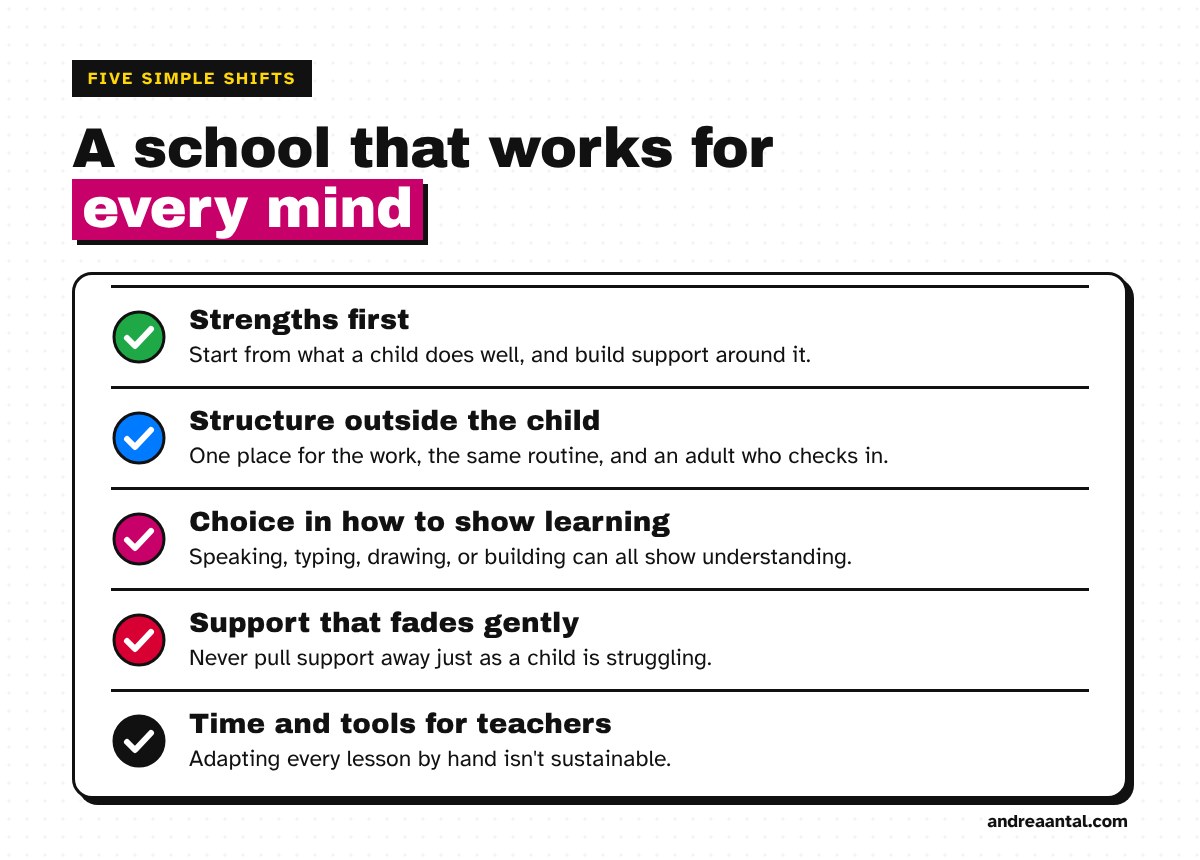
- Strengths first. Start from what a child does well, and build support around it.
- Structure outside the child. One place for all the work, the same routine every week, visible checklists, and an adult who checks in. That isn't lowering expectations. It removes the barrier, so effort goes into learning.
- Choice in how to show learning. Speaking, typing, drawing, or building can show understanding just as well as a long written answer.
- Support that fades gently. Taking support away suddenly, just as a child is struggling, undoes months of progress.
- Time and tools for teachers. Adapting every lesson by hand isn't sustainable, and it shouldn't have to be. Small classroom changes go a long way.
Small steps, real change
None of this has to happen overnight. As a parent, and in everything I've learned in my coach training, I've found that the changes that stick are rarely dramatic. It's one routine that stays the same every week. One honest conversation between home and school. One teacher who's willing to try something different. Keep at it, and that's how a whole system starts to shift.
That's exactly why I built WizdoBee. It takes a school's own lessons and adapts them to each student's support plan, so every child gets the lesson in a way that works for them, and teachers don't have to carry it all on their own. It's also why I'm training as an ADHD coach, and why The Bully Effect exists. Really, they're three answers to one question: what would school look like if we designed it for the children who are actually sitting in it?
Children shouldn't have to shrink to fit school. School can grow to fit them.
If this sounds like your family or your school, have a look at my free resources, or join the waitlist to hear when coaching opens.