A message left on “seen.” A teacher's comment in red pen. A partner saying, “Can we talk later?” For many people with ADHD, moments like these don't just sting. They land like a verdict on who you are, and the feeling can take over the whole day.
Rejection sensitive dysphoria, or RSD, is the name many people use for that experience. Here's what we know, what we don't know yet, and what can help.
What RSD is, and what it isn't
The term was popularized by psychiatrist Dr. William Dodson. It isn't a formal diagnosis, and you won't find it in the diagnostic manuals. Researchers usually talk about rejection sensitivity and emotional dysregulation, meaning feelings that arrive fast, run strong, and take longer to settle. Emotional dysregulation is common in ADHD (Shaw et al., 2014).
Research on rejection sensitivity in ADHD is still small, but it's growing. In one study, young teens with more ADHD symptoms showed stronger brain responses to peer rejection, and weaker responses to acceptance (Babinski et al., 2019). In another, university students with ADHD described rejection sensitivity as overwhelming and physical, with chest tightness or nausea, lasting hours or even weeks. Many said they hid it from others (Rowney-Smith et al., 2026).
Rejection sensitivity can also come with anxiety, low mood, or past hurt. If it's affecting your mood or daily life, a doctor or therapist is a good next step.
What a rejection wave looks like
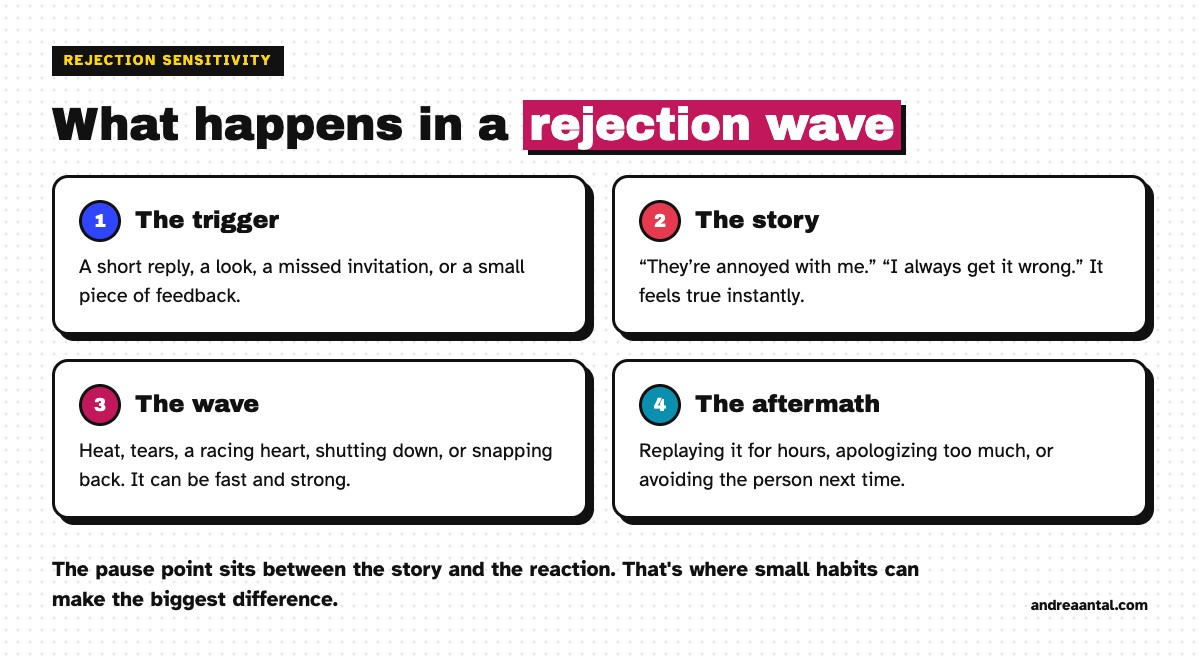
The trigger is often small. The story your brain tells about it is what turns up the volume. That's good news, because the story is the part we can learn to question.
How it can show up at different ages
- Rereading a group chat for hours
- Quitting a team after one critical comment
- “I don't care” as armour
- Not applying for jobs or programs to avoid a “no”
- Spending an evening rewriting a two-line email
- Over-apologizing and people-pleasing
- Dreading reviews, or snapping back at feedback
- A note from school about your child feels like a judgment of your parenting
- Holding back from asking for help
Five things to try in the moment
- Name it. “This is a rejection wave. It's strong, and it will pass.” Naming a feeling can take some of the heat out of it.
- Body first. Splash cold water on your face, walk around the block, or take a few slow breaths with a long exhale. Calm the body before you reply.
- Check the story. What do I know for sure? What are two other explanations? (They're busy. Their phone died. They're having a hard day.)
- Draft, don't send. Write the reply, then wait an hour. Most messages read differently later.
- Ask instead of assuming. “I noticed you seemed quiet. Are we okay?” is braver, and usually kinder, than guessing.
What helps over time
Keep a kind-words file. Save messages, cards, and feedback that went well. On hard days, it's evidence that the story isn't the whole truth.
Ask for feedback in a way that works for you. A heads-up before a review, written notes, or “one thing that's working and one thing to change” can make feedback easier to hear.
Practise repair. Relationships where it's normal to say “That came out wrong, can we try again?” make rejection feel less final.
Notice the pattern. Which situations set off a wave? Knowing your triggers lets you plan ahead.
Want it on paper? Download my free Pause plan and fill it in on a calm day.
Words that help
For parents, partners, teachers, and managers, a few small changes in wording can make a big difference:
Feeling things deeply isn't a flaw. With a few tools, the wave can pass without sweeping you away.
Want a head start? Try one of my free two-minute quizzes, or join the waitlist to hear when coaching opens.
Research mentioned: Shaw, P., et al. (2014). Emotion dysregulation in attention deficit hyperactivity disorder. American Journal of Psychiatry, 171(3). doi.org/10.1176/appi.ajp.2013.13070966. Babinski, D. E., et al. (2019). Sensitivity to peer feedback in young adolescents with symptoms of ADHD. Journal of Abnormal Child Psychology, 47(4). doi.org/10.1007/s10802-018-0470-2. Rowney-Smith, A., et al. (2026). The lived experience of rejection sensitivity in ADHD: A qualitative exploration. PLOS ONE, 21(1). doi.org/10.1371/journal.pone.0314669.