In the meeting, they're the one connecting dots no one else saw. Afterwards, the follow-up email sits unsent for a week. Then they stay late, quietly catching up and hoping no one notices. That gap between ability and output is what ADHD at work often looks like.
This page brings together what I've written for employees, managers, and HR teams, with links to practical tools you can use straight away.
More common than you might think
A global review estimated that around 2.6% of adults have ADHD that has continued since childhood, and around 6.8% have ADHD-level symptoms as adults, whether or not anyone noticed them in childhood (Song et al., 2021). A study of workers across ten countries found that about 3.5% met criteria for ADHD. It was linked with roughly 22 extra days of lost work performance a year, and most of that happened while people were at work, not off sick (de Graaf et al., 2008).
In other words, most of the struggle is invisible. People are showing up and working hard. They're just working against the grain.
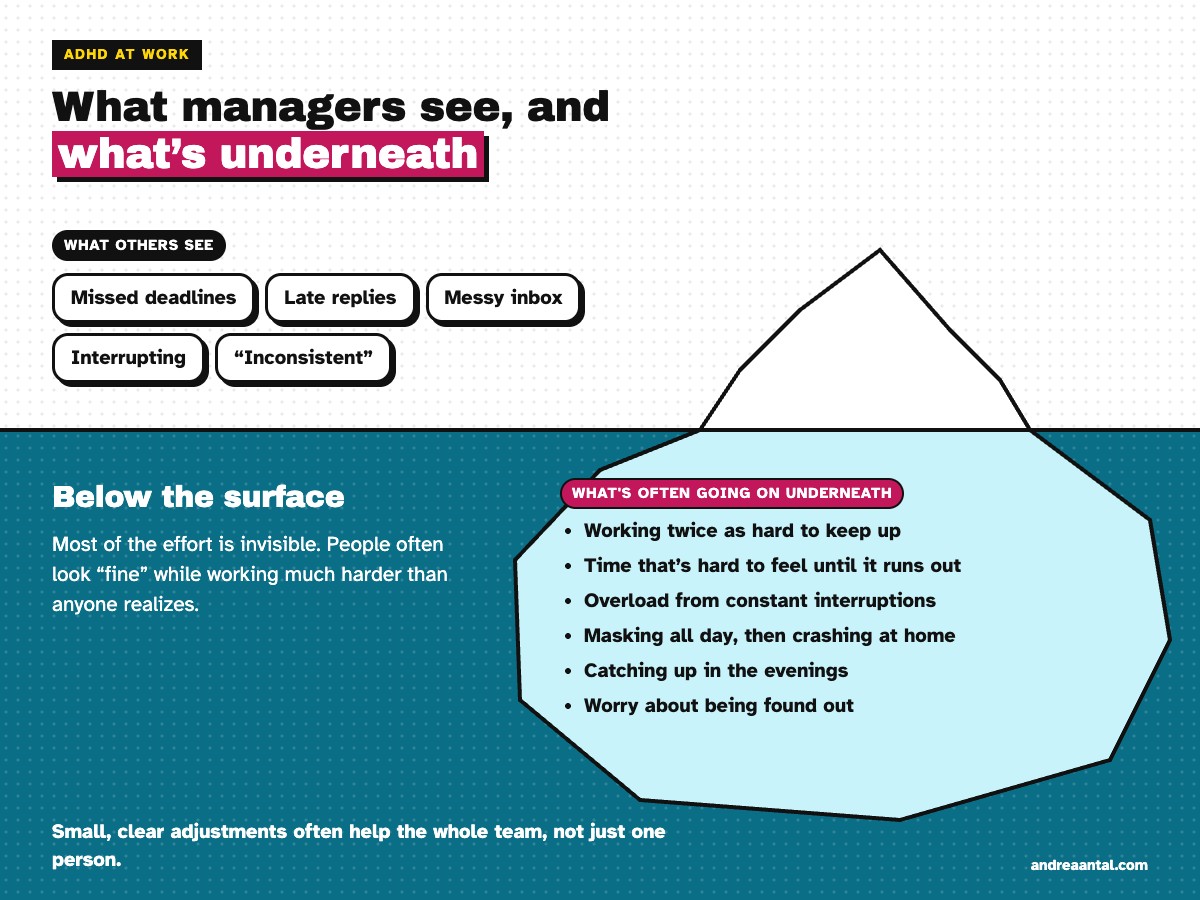
What ADHD can look like at work
- Big projects stall at the start
- Bursts of brilliant work right before a deadline
- Underestimating how long things take
- Late to a meeting after “one quick thing”
- Verbal instructions slip away
- Losing the thread in long email chains
- One interruption costs an hour
- Hyperfocus on the interesting part, while admin waits
- Feedback can hit hard (more on rejection sensitivity)
- Frustration with slow processes
- Creative problem-solving and pattern spotting
- Calm in a crisis, energy for new ideas
If you're the one with ADHD
Get it out of your head. Write tasks, deadlines, and promises somewhere you'll see them. Your memory is for ideas, not storage.
Protect focus time. Block 60 to 90 minutes in your calendar, silence notifications, and let colleagues know when you'll check messages. My free Focus and follow-up planner can help.
Make big work smaller. Turn “do the report” into the first step you can finish in ten minutes. The Break It Down worksheet can help.
Ask for things in writing. A quick “Could you send me the key points?” after a meeting is a reasonable, professional request.
Know what adjustments are possible. Many are simple and free. See my guide to ADHD workplace adjustments, and if stuck is the problem, how to get moving again.
My free Adjustments prep worksheet helps you plan what to ask for, and how much to share.
If you manage someone with ADHD
You don't need a diagnosis on file to make work clearer for everyone. Agree on priorities in writing, hold short regular check-ins, give feedback that's specific and private, and judge results rather than the route taken to get there. My checklist for managers and guide to supporting an employee with ADHD go step by step.
Small changes, usually low cost
Adjustments are often far cheaper than people expect. In a long-running survey by the Job Accommodation Network, more than half of employers who shared cost information said the accommodations they made cost nothing at all.
In the UAE, the rights of people of determination are set out in Federal Law No. 29 of 2006, and Cabinet Resolution No. 43 of 2018 refers to reasonable accommodation at work. How these apply depends on your situation and employer, so it's worth checking with HR or a legal adviser.
For teams and organizations
Many of the changes that help people with ADHD, like clear priorities, fewer interruptions, and written follow-ups, help the whole team. If you'd like to build that understanding across your organization, see workplace coaching and workshops and join the waitlist.
When work fits how a brain works, everyone benefits.
Want a head start? Try one of my free two-minute quizzes, or join the waitlist to hear when coaching opens.
Research mentioned: Song, P., et al. (2021). The prevalence of adult attention-deficit hyperactivity disorder: A global systematic review and meta-analysis. Journal of Global Health, 11. doi.org/10.7189/jogh.11.04009. de Graaf, R., et al. (2008). The prevalence and effects of adult ADHD on the performance of workers: Results from the WHO World Mental Health Survey Initiative. Occupational and Environmental Medicine, 65(12). doi.org/10.1136/oem.2007.038448. Job Accommodation Network. Costs and benefits of accommodation. askjan.org/topics/costs.htm.