I was diagnosed with ADHD at 45.
I didn't go looking for my own diagnosis. I recognized myself while learning about ADHD for my son, and then on my coaching course, where most of my classmates had been diagnosed as adults. I'd been struggling alone with attention, memory, and organization for as long as I could remember. In the end I just felt I needed to know.
When my psychologist told me I met the criteria for ADHD, my first feeling was relief. A label didn't fix anything, but now I could start looking for tools that actually fit how my brain works.
If you've had an ADHD diagnosis later in life, you may know that mix of feelings well. One minute it's "So that's why." The next it's "Why didn't anyone notice sooner?" Both reactions are normal, and you're allowed to have them on the same day.
Why so many adults are diagnosed late
For a long time, ADHD was seen mainly as something affecting young, hyperactive boys. Plenty of people slipped through:
- children who did well at school,
- children who worked twice as hard to keep up,
- children whose ADHD looked more like daydreaming than disruption.
Girls and women are especially likely to be missed. A systematic review of ADHD in adult women found that women are often diagnosed later than men. Their traits tend to be less visible, they often develop ways to compensate, and they're more likely to be treated first for anxiety or depression.
Some of the reasons are practical. In my assessment I did well on the computer tests. That was a quiet room, one thing to do, and clear instructions. My psychologist explained that this is exactly why tests like these can miss ADHD in adults. My real life looks more like a kitchen with a TV on, three people talking, and a to-do list running in my head. I still lose track of an instruction from my Pilates teacher halfway through a move.
Many late-diagnosed adults have also spent years building workarounds. Long before my diagnosis, I'd quietly built systems to get by. I left extra time, kept my keys and bag in the same place every day, and prepared for everything. I only realized recently that I'd been coaching myself for years without knowing why I needed it. Workarounds like these can take you a long way, but they also take a lot of energy, and they can hide how hard things really are.
The relief: "So that's why"
For many people, the first feeling is relief. A Swedish study of adults diagnosed with ADHD found that the diagnosis helped people make sense of long-standing struggles and feel better about themselves.
A 2026 review of 21 studies, covering nearly 400 adults, found something similar. For many, the diagnosis ended years of self-blame.
The relief often comes from swapping one explanation for another. "I'm lazy" becomes "my brain manages attention differently." "I'm a mess" becomes "I've been running without the right tools."
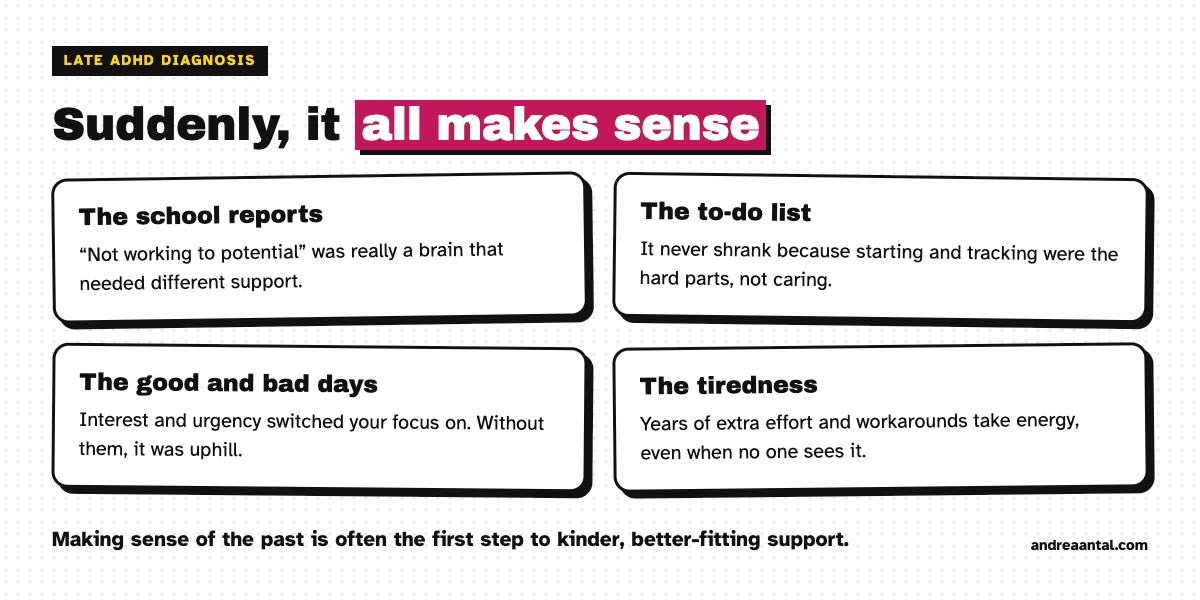
The grief: "Why didn't anyone notice?"
The same review found that relief often sits alongside grief and anger over "lost time." People think about:
- the report cards that called them careless,
- the jobs they left,
- the relationships that struggled,
- how much harder everything felt than it needed to.
Grief here doesn't mean something is wrong with your diagnosis. It's a sign that you're taking your own history seriously. Give it room, but don't let it be the whole story.
- "It finally makes sense."
- "It wasn't a character flaw."
- "Now I can find tools that fit."
- "I wish I'd known sooner."
- "Things could have been easier."
- "Why didn't anyone notice?"
The story you tell yourself
A diagnosis doesn't automatically erase the labels you grew up with. "Too much," "all over the place," "doesn't apply herself," "lazy." Labels like these can stay with you long after the circumstances that created them.
One of the most useful things you can do after a late diagnosis is look at those labels again, with better information.
Try this: rewrite one old label
Pick one label you absorbed growing up. Then write three things: the old label, what was actually happening, and a fairer description. Here are some examples.
You don't have to believe the new description straight away. Just write it down where you'll see it again.
"Which parts are me, and which are ADHD?"
After a late diagnosis, some people go through a wobble about who they are. The 2026 review describes a temporary identity crisis: people unsure which of their traits were their own and which were "just ADHD."
For the first few weeks I caught myself analyzing every moment: was that ADHD, or something else? It was fascinating, but it started to feel like another job. I don't need to label every reaction. If something drains me, I can respond to that, whatever the explanation.
I find it more helpful to see ADHD as part of you, not all of you. Your curiosity, humour, values, and the way you care about people are still yours. ADHD affects how you manage attention, time, and energy. It doesn't replace who you are. As I explain in Is ADHD a superpower or a disability?, how it shows up depends a great deal on where you are and what you're being asked to do.
Who to tell, and when
You don't owe anyone your diagnosis. Some people find that having a name for it helps them explain their needs to a partner, a friend, or a manager. Others prefer to keep it private, at least for a while. The research suggests both experiences are common. Close relationships often become more understanding, while wider circles can be less informed or more sceptical.
If you're unsure, start with one person you trust. Notice how it feels before deciding on the next.
Gentle next steps
- Write a short timeline. Note three to five moments from your past that make more sense now. Keep it factual and kind.
- Find what already worked. Like my extra time and fixed places for my keys, you probably built strategies long before you had a name for why. Write down one you want to keep.
- Add one small support. For example a visible to-do list, a timer for transitions, or working alongside someone. One is enough to start.
- Give your feelings time. If grief, low mood, or anxiety feels heavy or lasts, talk to your doctor or a therapist. You don't have to work it out alone.
A diagnosis can also open new questions. Some adults start to wonder whether autism is part of the picture too, which is sometimes called AuDHD. Others finally have words for why criticism has always hit so hard, often described as rejection sensitivity. Both are worth looking into, at your own pace.
If you'd like to see your own patterns more clearly, my free two-minute quizzes look at starting, planning, time, and focus, and send you a short personal report.
You can't change the past, but you can change how you see it
A late diagnosis doesn't give you back the years. What it can give you is a kinder, more accurate way to read them, and better tools for what comes next.
Join my waitlist to hear first when spaces open. You don't need a diagnosis to work with me. You can read more about ADHD coaching for adults or my own story.